Myanmar’s planned election cannot legitimize a regime waging war on its own people—peace, accountability, and inclusive dialogue must come first.
By Salai Za Uk Ling
As Myanmar’s military junta prepares to stage a national election in December, it does so not in the spirit of democratic renewal but amid a campaign of terror that has displaced millions and devastated entire regions. Villages have been burned to the ground, churches and hospitals bombed, and civilians executed in cold blood. The same generals responsible for these crimes now seek to drape a veneer of legitimacy over their rule through the ballot box.
The path to election cannot be paved with blood and crimes.
Since the coup of February 2021, the military—formally known as the State Administration Council (SAC)—has waged a systematic war against its own citizens. Airstrikes and artillery barrages have destroyed civilian infrastructure across the country, particularly in the western Chin hills and the Sagaing Region. Ground forces have carried out mass killings, arbitrary arrests, and sexual violence. The United Nations and independent human rights mechanisms have documented patterns of atrocities amounting to war crimes and crimes against humanity.
Instead of facing justice, the generals now seek legitimacy through a tightly controlled electoral process designed to entrench their power and fragment the nationwide resistance. But no election can be free or fair under martial law, where opposition voices are silenced and millions of displaced people are unable even to vote.
War Disguised as a Political Process
In recent weeks, the Chin Human Rights Organization (CHRO) has verified the mobilization of major combat units—including Light Infantry Divisions 77 and 99—along the Chin–Sagaing frontier. Senior commanders from several regional operations commands have converged to oversee renewed offensives aimed at clearing territory ahead of the junta’s so-called “election.” Troop movements, air raids, and scorched-earth operations have intensified in tandem with the regime’s narrative of “stability” and “reconciliation.”
This is not preparation for an election; it is a campaign of military conquest designed to subdue resistance strongholds and fabricate an illusion of control. In practice, the junta is once again turning its weapons against civilians.
At the United Nations Human Rights Council’s 60th Session in September, I warned that the junta’s election preparations are inseparable from its ongoing campaign of terror. Speaking live on UN WebTV, I urged member states not to confuse coercion with consent or mistake the junta’s electoral charade for political progress. Any attempt to normalize relations with the regime risks legitimizing its crimes and undermining the sacrifices of millions who continue to resist military rule.
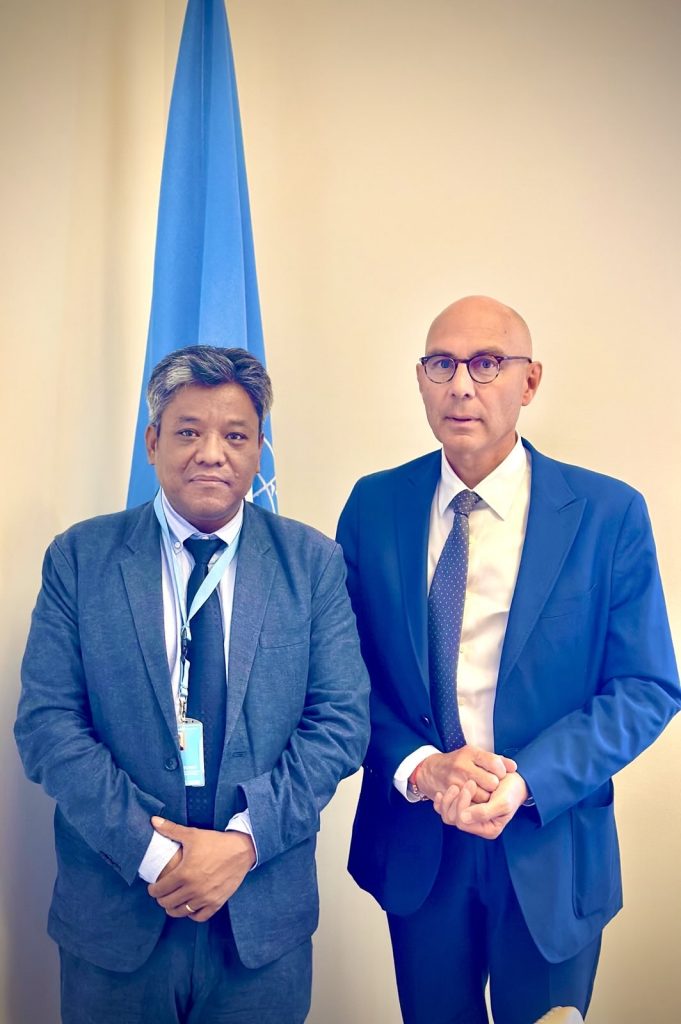
Following that session, CHRO carried these messages directly to governments and international institutions across Europe. In London, Dublin, Geneva, and Brussels, we met with senior officials, parliamentarians, and diplomats to urge stronger action against the junta’s crimes and greater support for Myanmar’s democratic movement. In Geneva, I held a private meeting with the UN High Commissioner for Human Rights to raise concerns about escalating military offensives in western Myanmar and the junta’s use of elections as a tool of repression. In Brussels, our team engaged with the European External Action Service, the European Commission, and the European Parliament to emphasize the urgent need for coordinated humanitarian and political responses.
These efforts reflect CHRO’s conviction that advocacy must not end with documentation—it must translate into diplomacy, solidarity, and concrete action to prevent further atrocities and uphold international human rights norms.
The Human Cost of the Junta’s War
For the people of Chin State, the suffering is staggering. More than half of the population—some 280,000 people—have been forcibly displaced since the coup. Entire towns—among them my birthplace and hometown, Thantlang—have been reduced to ashes after repeated air and artillery attacks. Once a peaceful town nestled in the hills near the Indian border, Thantlang now stands deserted, its homes and churches destroyed, its residents scattered across forests and refugee camps.
Tens of thousands of Chin people have fled into India, while others survive in makeshift shelters with little access to food, medicine, or education. Humanitarian access remains severely restricted. The junta blocks aid convoys and targets local relief networks. As a result, communities depend almost entirely on cross-border assistance and church-based humanitarian systems sustained by diaspora contributions. Yet international funding for Myanmar’s western frontier remains woefully inadequate, leaving millions vulnerable to starvation and disease.
A Sham Election and the Risk of Legitimization
The junta’s planned “election” is not a step toward peace but an instrument of control. It seeks to impose a political structure that excludes the democratic opposition and ethnic resistance organizations while presenting a false image of national unity. Recognizing or tolerating such a process would not advance stability—it would reward atrocity and deepen the conflict.
Equally troubling are the junta’s civilian collaborators and political opportunists now preparing to contest these elections under its shadow. Their participation serves only to validate the regime’s crimes and prolong the suffering of millions. They must know that complicity will not grant them immunity—those who enable tyranny will one day be held to account alongside its architects.
The international community must adopt a consistent and principled stance. The EU, ASEAN, and democratic partners should reject the junta’s planned elections unless there is a complete cessation of violence and the start of an inclusive political dialogue. ASEAN’s recent statement rightly makes any credible, free, and fair election conditional on these steps. ASEAN and its members must avoid any action that lends legitimacy to the junta’s sham process, while the EU should extend strong political and diplomatic support to reinforce this principled position.
At the same time, greater support should be directed to the democratic movement and local governance structures that have emerged in resistance-held areas. These initiatives—rooted in popular consent and accountability—represent the true foundations of a future federal democracy.
Accountability as the Path to Peace
Justice and accountability must be central to any international strategy on Myanmar. The Independent Investigative Mechanism for Myanmar (IIMM) has already collected extensive evidence of atrocity crimes, while universal jurisdiction cases in the Philippines and Indonesia show the potential for domestic courts to act where international mechanisms remain blocked.
Targeted sanctions against the junta’s military-linked businesses, aviation fuel suppliers, and arms networks remain vital. Equally important is sustained diplomatic engagement with neighboring countries—particularly India and Thailand—to ensure humanitarian corridors remain open and refugees are protected from forced returns.
A Moral Test for the International Community
The crisis in Myanmar is not merely a domestic political struggle; it is a test of the world’s commitment to justice, human rights, and democracy. Every airstrike, every civilian death, and every village burned in Chin State or Sagaing is a reminder that democracy cannot be born from terror.
The international community must draw a clear line: legitimacy cannot be conferred on perpetrators of mass atrocities. Silence or complacency will only embolden the generals to continue their crimes with impunity.
The people of Myanmar have already chosen democracy with their lives and their resistance. It is time for the international community to choose moral clarity over convenience.
The path to a genuine election must begin with accountability, not impunity—with peace, not blood. Until then, any ballot cast under the junta’s rule will be stained with the crimes of its creators.
Salai Za Uk Ling is the Executive Director of the Chin Human Rights Organization (CHRO), a Myanmar-based organization with UN ECOSOC Special Consultative Status that works to promote human rights, religious freedom, and justice for the Chin people and all communities in Myanmar.